
Google recently announced their “Gemini Intelligence” update for Android at this year’s Android Show | I/O Edition, signaling a shift to making our phones more “Agentic”. Gemini Intelligence will be powered by the Gemini 3.1 Pro model, and will bring more agentic AI features that allow your phone to understand your context, anticipate your needs, and execute complex multi-step tasks (this soundly oddly familiar right?)… Did someone say Apple… Intelligence??? 😅
Now, in order for us to understand how this shifts the mobile AI landscape, we need to look at what Gemini Intelligence actually does, how it compares to its primary rival Apple Intelligence, and why the jokes about Apple Intelligence are suddenly not aging well…
The Core Features of Gemini Intelligence
The word “intelligence” pretty much sums up the fact that Gemini Intelligence, like Apple Intelligence will be able to take action on your behalf, understand your personal context and integrate with other features to build a connected ‘digital experience’.
Here are the standout features:
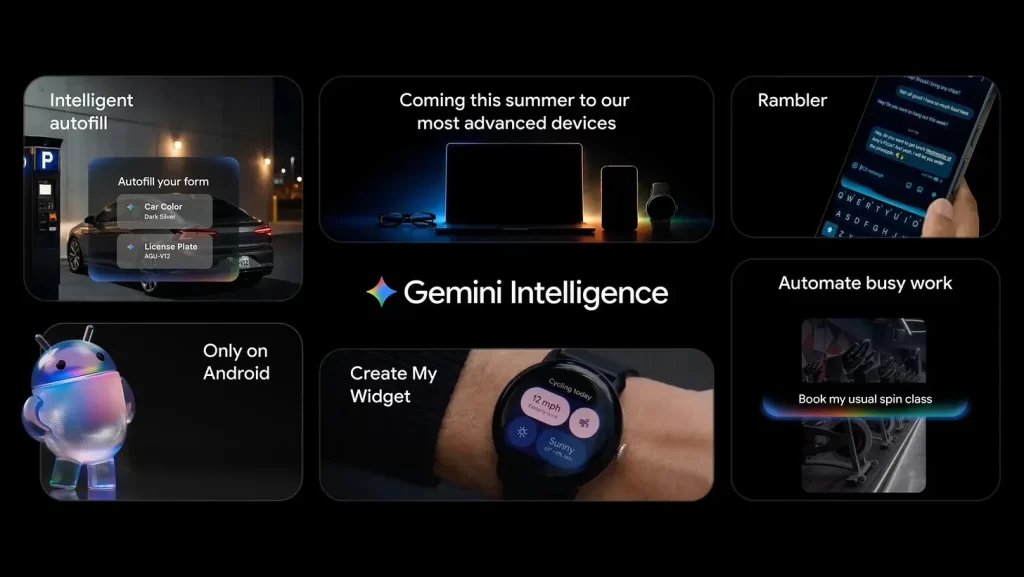
- Cross-App Task Automation: This is the flagship capability. Gemini Intelligence will be able to navigate through third-party apps on your behalf. You will be able to just point your camera at a physical travel brochure and tell your phone to find a similar tour on Expedia for six people (similar to Apple’s Visual Intelligence), it will then open the app, input the parameters you asked for, and send you a notification when it is ready for you to hit confirm.
- The “Rambler” Tool: Because it wants to be natural and understand that we all leave messy, unstructured voice notes that are filled with pauses and filler words, the Rambler feature will take those chaotic and unstructured spoken thoughts and instantly refine them into polished text messages (I actually like this because no one speaks/dictates in perfect speech).
- Create My Widget: Now this feature reminded me of Nothing and their Essential Apps feature that allows you to describe the App or Widget you want in Natural Language and it will automatically build it for you. And that’s how the feature will function, you will just use natural language to describe to what you want, and Gemini will generate a custom, working widget for your home screen.
- Next-Gen Creative Integration: The broader Gemini ecosystem is also bringing huge creative applications to our phones, which include Nano Banana 2 (the model that handles text-to-image and complex style transfers) and Veo, Google’s video generation model for creating high-fidelity clips natively on your device.
Gemini Intelligence vs. Apple Intelligence
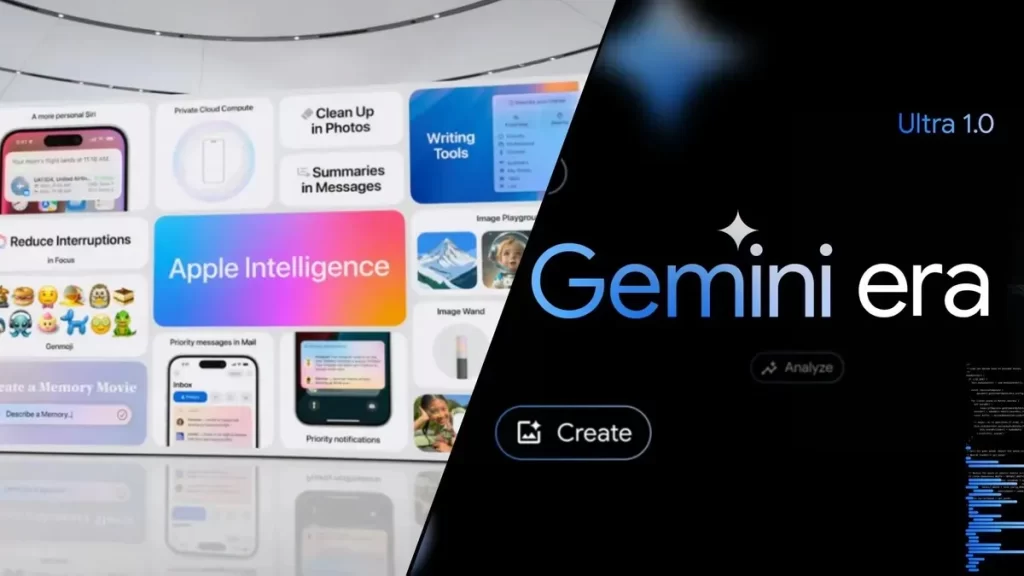
Lets face it, in as much as it seems as though Google copied Apple’s approach with Gemini Intelligence, there is hope that Google will execute it better because of the AI technology they have as opposed to Apple who promised us Agentic AI features they never delivered.
I do think though it is worth just looking at how these two companies approached their “intelligence” models:
The Apple Intelligence Approach
Apple has built their AI strategy around strict on-device processing and deep privacy integration, which relied heavily on smaller, highly optimised models running directly on the iPhone’s neural engine. What this means is, when a task is too complex, it passes the request to its Private Cloud Compute network.
When it comes to the User Experience (UX), Apple Intelligence is deeply tied to Siri, which was also overhauled as a result. This in turn “made” Siri (and I say made in quotation marks) into a system-wide orchestrator that understands personal context within the Apple ecosystem.
(Spoiler, it never actually got to understand your personal context or take actions as promised).
The Gemini Intelligence Approach
Google is leaning heavily into their Cloud supremacy and ecosystem flexibility through Android in this case, because what makes Gemini Intelligence different is that yes, they emphasise privacy with granular user controls and opt-in settings, however it does have agentic capabilities.
Because it is backed by the massive context window of Gemini 3.1 Pro, it can process significantly more complex inputs, like summarising entire web pages, reading multiple PDFs simultaneously, and performing multi-step actions across various third-party Android apps (which is something Siri and Apple Intelligence still fail to do). In addition to this, they are a step ahead of Apple because Apple focuses on keeping your data locked down within its own apps and ecosystem, while Google focuses on reaching across different apps through the Android ecosystem to automate your tasks.
Samsung…. Jokes turning into their reality?
For years, Samsung has treated Apple product announcements like a roast battle.
When Apple removed the headphone jack, Samsung ran ads mocking them (only for them to remove it as well). When Apple introduced the notch to the iPhone X, Samsung made commercials featuring people with notch-shaped haircuts. Even when Apple removed the charging adapter in their phone boxes, Samsung mocked them and then proceeded to also remove it from their boxes as well. More recently, when Apple released a slightly dystopian ad showing creative instruments being crushed by an iPad, Samsung immediately released a counter-ad defending human creativity.
Fast forward to 2024 when Apple announced Apple Intelligence, Samsung loyalists and marketers were quick to poke fun at the somewhat uninspired name and the fact that Apple was “late” to the AI party because at the time, Samsung had already been pushing its early “Galaxy AI” features.
Now, in 2026 the irony is laughable.
Samsung is pretty much adopting the same playbook through Google and Gemini Intelligence, effectively adopting the exact same thing they were just mocking. I mean what’s even more funnier, Samsung took their long-neglected Bixbyvoice assistant, and rebranded it as a language-based “device agent” that operates almost identically to Apple’s revamped Siri.
The jokes write themselves sometimes I guess…