
Do South Africans really care about iMessage bubbles?

If you’re like me and you spend an ungodly amount of hours watching tech reviews or following the U.S. tech culture, you’ll know that everyone now and again the blue versus green bubble debate is always a conversation. It’s a massive cultural phenomenon in the U.S., which for all intents and purposes dictate social dynamics and even dating preferences (who would have thought?).
But whenever I look at my own phone, right here in South Africa, I realise how irrelevant the blue bubbles vs green bubbles debate is for us. I mean, I am deep in the Apple ecosystem, I use 2x iPhones (work and personal) , Apple Watch, MacBook Pro and every single one of my friends has an iPhone. You would think our group chats would be on iMessage as part of the blue bubble gang right?
Wrong!.
If you open my iPhone, the very first messaging app you’ll see with multiple notifications is always WhatsApp. Even amongst a group of exclusive iOS users, WhatsApp is still very popular amongst South Africans. It makes you wonder why we ignore the seamless, interconnected messaging features baked directly iMessage.

Is it a popularity over functionality thing? Habit? Or is it something else?
The Legacy of the Instant Messaging
To understand our habits, one would have to look back at how South Africans communicated before modern smartphones took over the market. Historically, standard SMS in this country was exceptionally expensive on a per character basis when compared to internet data, costing at around R0.50 for each.

But besides SMS and long before iMessage or WhatsApp existed, platforms like Mxit, 2go WeChat and BlackBerry Messenger (BBM) conditioned us to use Instant Messaging over the internet. They created a massive demand for affordable alternatives to traditional text messages and by the time iPhones gained traction locally, the culture of platform agnostic messaging was already deeply entrenched in our daily lives (everybody wanted to be on BBM or MXit.)
The False Promise of RCS
Recently, Apple finally introduced support for RCS, or Rich Communication Services, starting with iOS 18 (after being “forced” by the EU).
This was supposed to be the bridge between iMessage and Android, promising high resolution media, typing indicators, and read receipts across both platforms (while still maintaining the green bubbles of course 😅). And the thing is, you would assume this update would have finally loosened the grip of third-party messaging platforms, but in South Africa, it’s a different story – RCS support still feels like an empty promise.
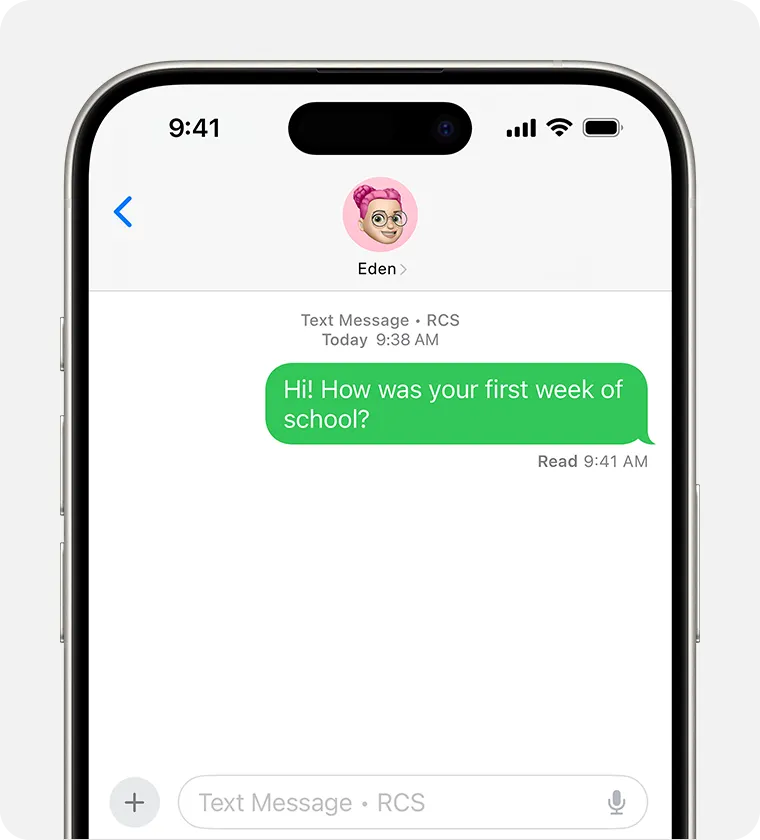
For RCS to work seamlessly on an iPhone, mobile network providers must actively support and enable the profile for Apple devices on their towers. As it stands, our major networks like Vodacom, MTN, and Telkom have yet to adopt or properly support RCS for iOS (which feels like it’ll never happen at this point deep in iOS 26), so while tech reviewers and journalists abroad celebrate this new cross platform peace treaty, any text I send to an Android user from my native Messages app still drops down to an archaic, compressed SMS – defaulting me right back to WhatsApp.
The Gravitational Pull of the Network
Even if RCS worked flawlessly here, I doubt my habits would change because of the pull of the network effect.
South Africa is undeniably an Android dominant market and while my immediate circle of friends might be entirely on iPhones, our extended families, colleagues, and the local businesses we interact with are not.
Effective communication often happens in groups and because we are forced to use WhatsApp to speak to our parents or our colleagues without breaking group chat functionalities or paying SMS fees, it naturally becomes the default hub for everything else. It simply makes zero sense to switch apps entirely when the only people I talk to on iMessage are my wife and one or two business associates.
The Default Operating System for Business

In South Africa, WhatsApp is not just for chatting with friends, it is the frontline of customer service and commerce. If you aren’t on WhatsApp, you are not in the game, unfortunately.
You can renew your car license disc, chat with a local pharmacy, get customer support from major retailers, or order from a neighborhood bakery all via WhatsApp Business, which is something iMessage fundamentally lacks because of the level of enterprise integration and consumer expectation in the South Africa.
Additionally, mobile networks in South Africa frequently offer affordable WhatsApp data bundles specifically tailored to keep the app connected on a budget. While my friends and I might not rely on those specific bundles, it reinforces WhatsApp as the default platforms of communication across the entire country.
Utility and inclusivity beats ecosystem exclusivity every time.
iMessage offers a polished and highly secure experience, however, it fails the fundamental test of South African communication, which is universal reach. For a South African iPhone user, iMessage is a nice-to-have feature that occasionally pops up for an OTP code. WhatsApp, on the other hand, is an absolute necessity.
The blue bubbles simply do not matter when the entire country runs on green.